

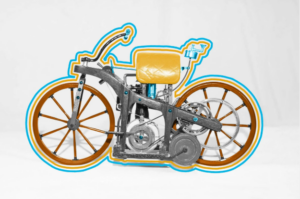
On November 10, 1885, German inventors Gottlieb Daimler and Wilhelm Maybach unveiled the first motorcycle. Known as the Reitwagen, or “riding car,” it had four wheels: two large wheels plus a pair of small stabilizers (sort of like training wheels) to help keep it upright.
Indeed, the wooden creation resembled a bicycle more closely than it did a modern motorcycle, and the low-mounted engine drove the rear wheel via a belt at a top speed of only about 7.5 miles per hour. Though crude by today’s standards, it demonstrated new possibilities for compact, engine-powered vehicles that could reliably carry a rider.
Just one year after the Reitwagen’s debut, Carl Benz introduced his motorcar, considered the first practical automobile. Benz’s car had just three wheels, a choice that was more practical than stylistic. Three wheels simplified steering, something Benz tinkered with until introducing his first four-wheeled vehicle, the Benz Victoria, in 1893.
The following year, German company Hildebrand & Wolfmüller introduced and began mass-producing the first two-wheeled motorized vehicle that was referred to as a motorcycle, though it went by the German word motorrad.